
Which Molding Projects Fit FHFC Hot Runners? Four Checks
Injection Molding Encyclopedia12 min read
On this page
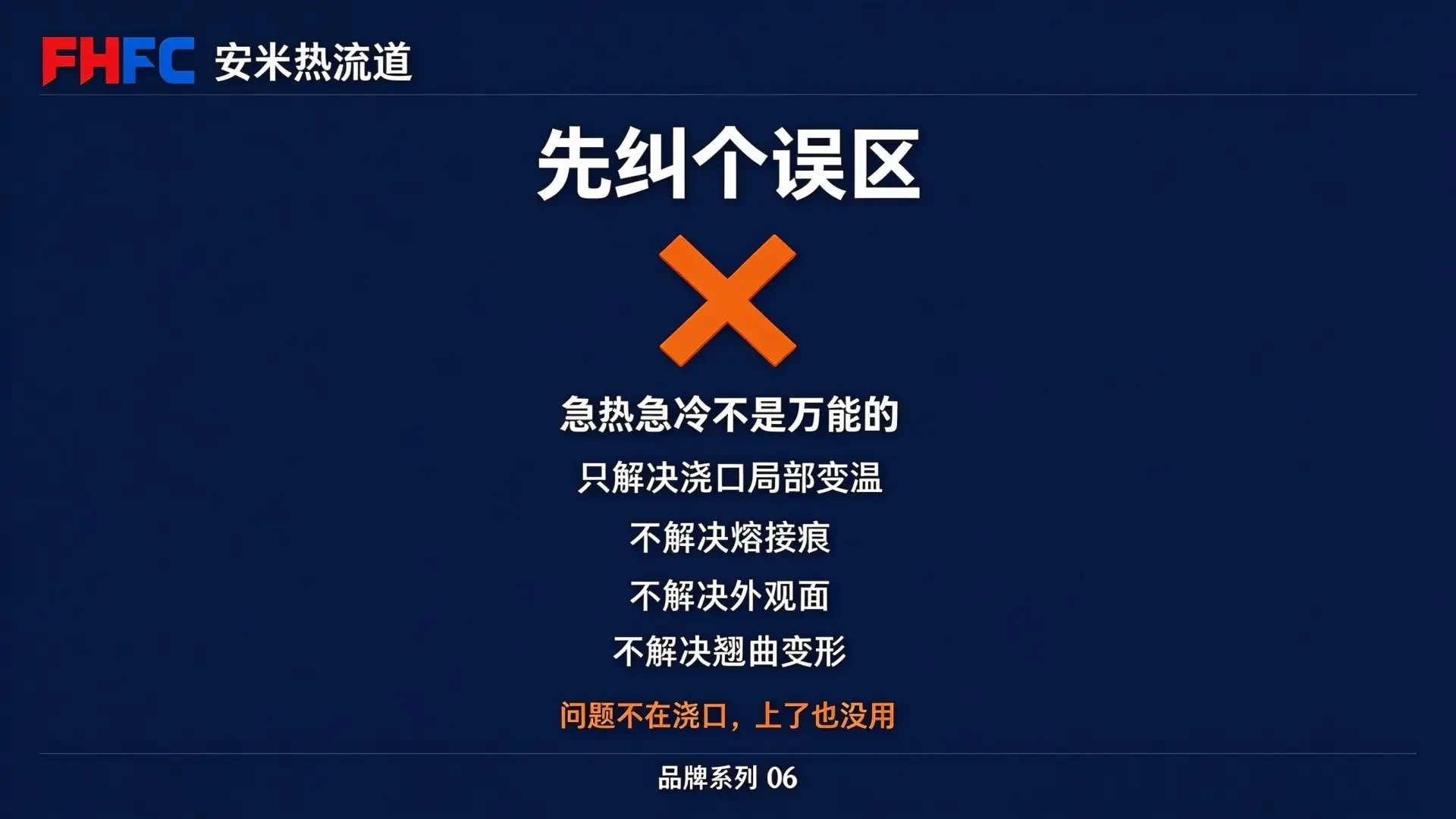
FHFC hot runners are not suitable for all injection molding projects. They address localized gate temperature changes to resolve stringing, drooling, and clogging; they do not equate to FHFC of the entire mold, nor do they solve weld lines, surface appearance issues, or warpage.
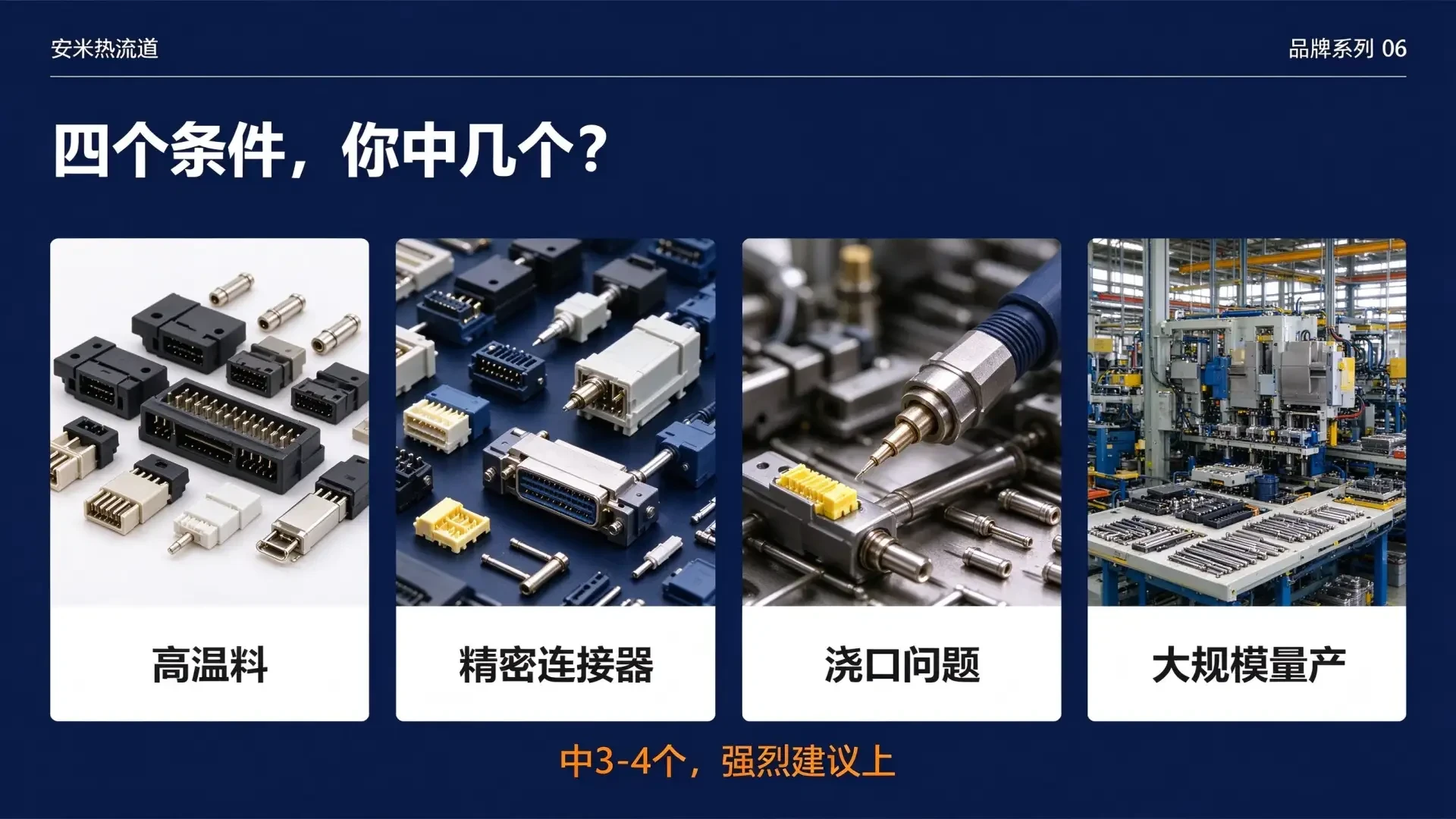
Suitability can be preliminarily assessed based on four criteria: material, product structure, existing pain points, and production volume. Self-check results are for screening only and do not replace project quotation and machine verification.
Define Application Boundaries First
The FHFC hot runner system is limited to the gate area. The manifold and runners maintain a constant temperature, while the gate temperature varies during injection, holding, and mold opening stages. This does not alter the overall cavity temperature or replace the mold cooling system.
Therefore, issues such as weld lines, surface defects, and warpage must be addressed through mold design, gate placement, material drying, venting, and cooling. These are outside the scope of this technology's solution.
Criterion 1: Is the material heat-sensitive or exposed to high temperatures?
Materials like LCP, PA6T, PA9T, PA46, PPS, and PEEK require high processing temperatures and have narrow gate temperature windows. Heat-sensitive alloys such as PC+ABS are sensitive to residence time. These materials are more prone to stringing, drooling, or gate clogging.
Gate issues with common materials like ABS, PP, and PE are typically minor, and traditional constant-temperature structures often meet requirements. Material type is a necessary but not sole criterion for judgment.
Condition 2: Does the product depend on gate quality?
For products like precision connectors, micro electronic components, thin-wall parts, sensors, and coil bobbins, gate defects directly impact dimensions, appearance, or automated assembly. Ensuring gate stability is critical for fully automated mass production and minimizing manual post-processing.
For housings, daily necessities, and general structural parts, if minor stringing or drooling at the gate can be trimmed without affecting function or delivery, incremental investment is typically lower priority.
Condition 3: Are there any current gate defects?
Check existing production records: Do fine strands appear during mold opening? Is there leakage or dripping at the gate? Does nozzle clogging occur due to carbon buildup after several days of production? Does machine adjustment frequently oscillate between heating and cooling?
If two or more of the above issues persist and cause scrap, downtime, or manual cleaning, proceed to further cost analysis. If gate conditions are stable, do not add configurations solely based on technical terminology.
Condition 4: Is production volume sufficient to amortize the investment?
Projects with multi-cavity molds, continuous production, and high annual output offer greater room for amortizing incremental investments. A one percentage point reduction in defect rate corresponds to easier quantification of savings from reduced scrap.
For small-batch prototyping or low annual volume projects, the return on incremental investment is limited. Calculate specific benefits using unit cost, annual production volume, current defect rate, and downtime records; do not use uniform monetary estimates.
Understanding the Four Self-Assessment Results
If all or most of the four conditions are met, proceed to project costing: confirm product structure, number of cavities, number of gates, material, and existing mold status before obtaining a specific quote.
If approximately two conditions are met, provide product and defect information for preliminary assessment. If zero to one condition is met, traditional constant-temperature hot runners typically suffice, requiring no additional configuration.
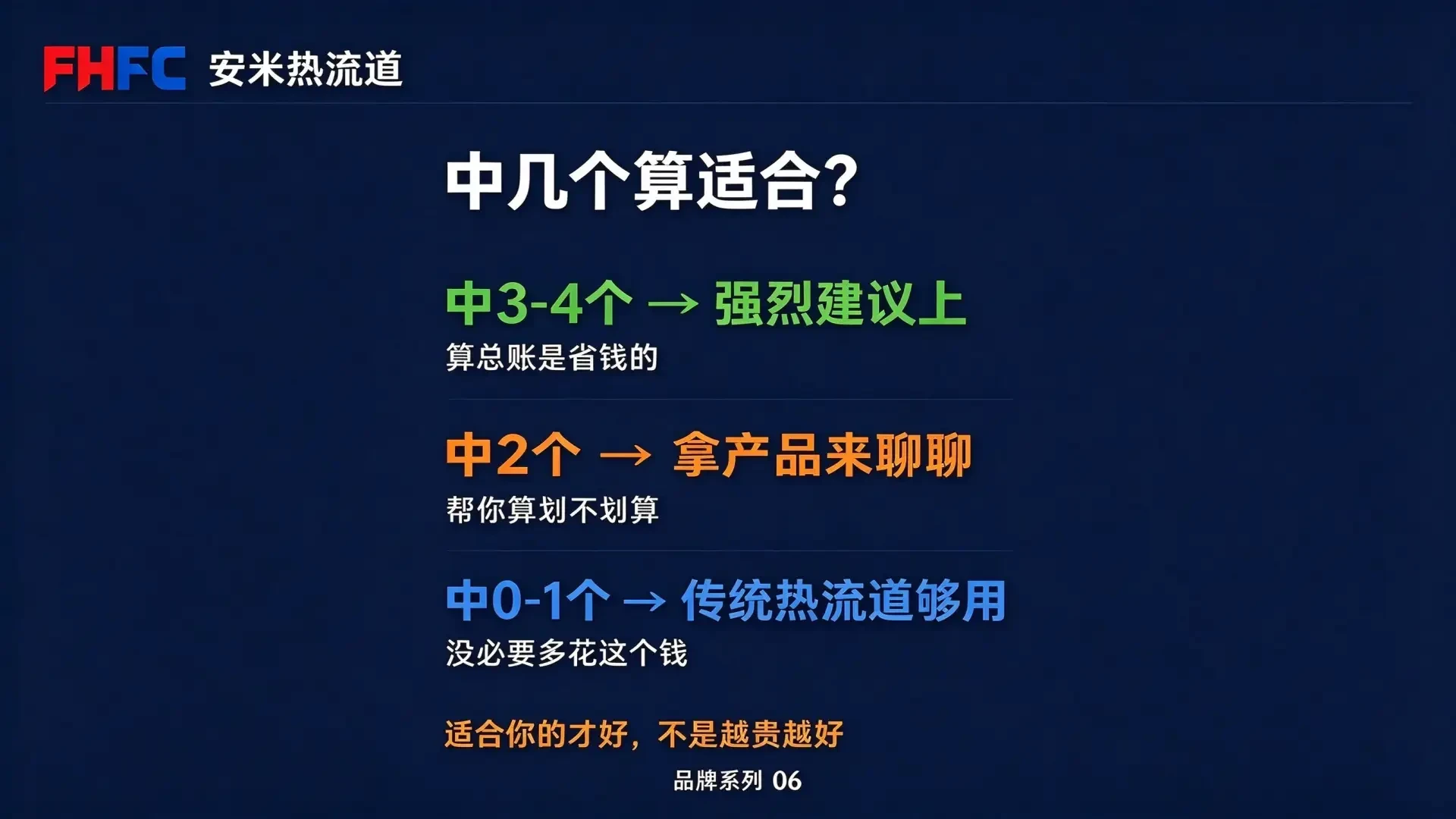
Self-checks cannot replace benefit calculations. Adoption decisions still require comparing incremental investment against quantifiable benefits, deducting new temperature control energy consumption and maintenance costs.
Conclusion
FHFC hot runner technology addresses localized gate temperature control and is not a universal upgrade. Its value is more evident when material, product, defect, and batch size conditions are simultaneously met; otherwise, traditional structures are usually more economical.
For assessment, provide material grade, product structure, number of cavities, existing defect types, annual production volume, and current defect rate. The technical team will determine suitability and provide configuration and quotation ranges accordingly.
MATCHED BY MATERIAL AND DEFECT
This article covers stringing, drooling, clogging, and high-heat resins; refer to SD for gate freeze and break-off.
Register for a selection review and quote
Submit part, mold, and material details. Our engineers will evaluate the gate solution per part and provide a quote.
Upload a 2D layout drawing using the form.
Online selection and quote
Scan to register