
Is PA9T stringing caused by moisture absorption or shear heating diluting the material?
问题排查16 min read
On this page
For a PA9T-based board-to-board connector with 35% glass fiber, at a nozzle temperature of 340°C, the extruded strands are as fine as spider silk and only visible under backlight. The customer's first question was whether the material had been insufficiently dried.
PA9T has a moisture absorption rate of only 0.19%, so hygroscopicity is not a major concern. The real cause of stringing lies elsewhere: shear heating at the gate.
First, rule out drying issues
PA9T (Kuraray Genestar G1350A) moisture absorption is 0.19% (ISO 62, 24-hour immersion at 23°C). Its long-chain diamine structure reduces amide group density, lowering water uptake. This is the key difference from PA46.
This does not mean drying is unnecessary. The manufacturer requires drying at 70–90°C for 4–8 hours, with moisture content kept below 0.20%. However, insufficient drying causes silver streaks, bubbles, and reduced strength—not fine strings.
A simpler troubleshooting step is to check the dryer's actual temperature instead of the setpoint. Low actual drying temperature, uncleaned hoppers, or incomplete regeneration can all cause moist material to enter the barrel. After verifying these three factors, move on from drying issues and focus on temperature control.
When fine strings appear, do not immediately review drying records—check the temperature first. This step can save an entire day.
Strings are drawn from the thinned melt
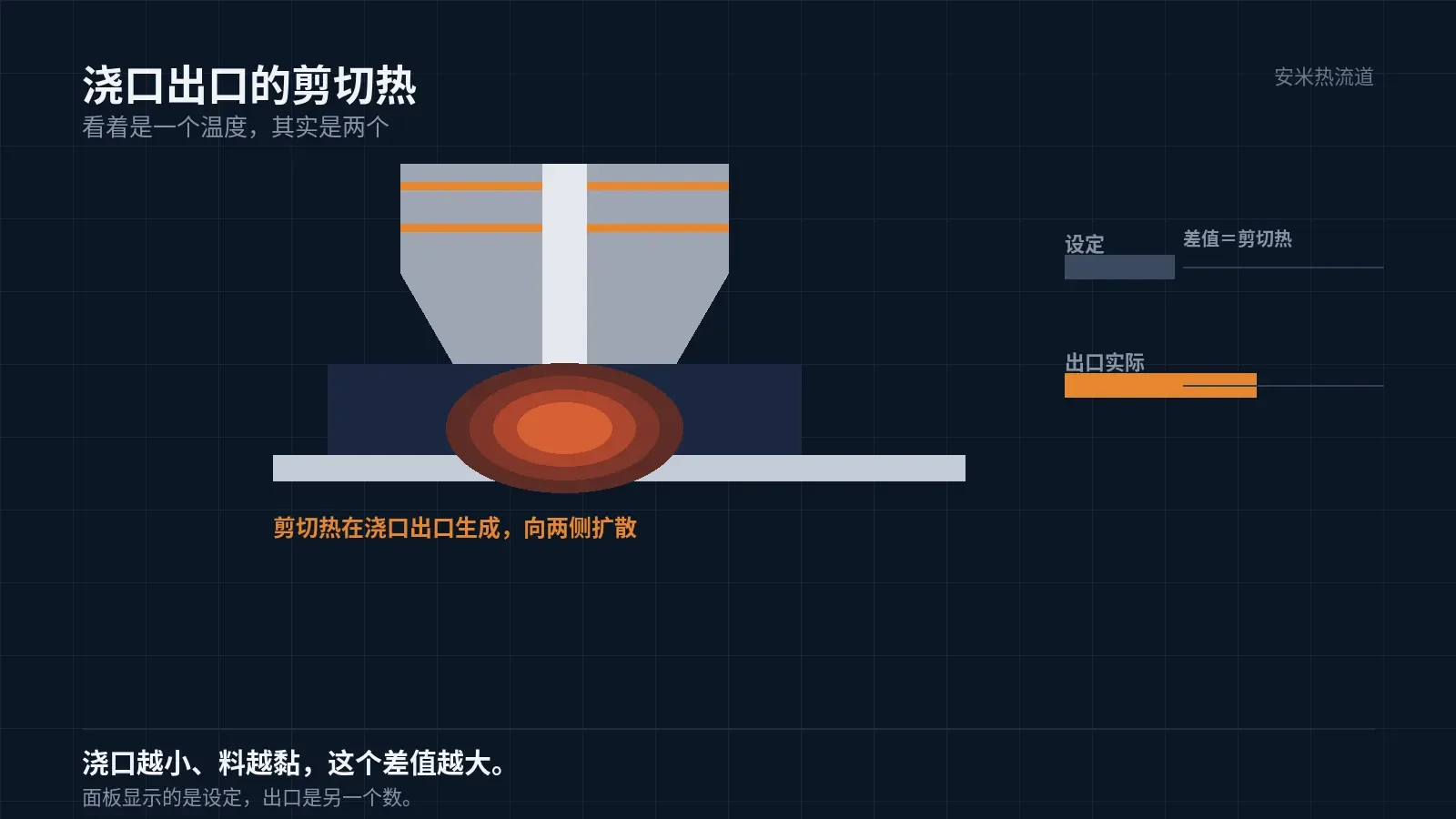
This grade contains 35% glass fiber. Glass fiber increases melt viscosity, leading to higher shear rates through gates of the same cross-section. Higher shear rates generate more shear heat, so the actual melt temperature at the exit is often higher than what the panel displays.
Shear rate is inversely proportional to the square of the gate diameter; halving the diameter approximately quadruples the rate. This is an estimate, not an exact value, but sufficient to determine the trend: smaller gates lead to higher shear heating and a thinner melt at the exit.
The hotter and less viscous the melt, the less cleanly it breaks at mold opening, causing the part to pull a strand. As a result, PA9T strings are thin, long, continuous, have uneven break points, and lack a skin.
In multi-cavity molds, log which cavities show stringing. If only specific cavities are affected, first measure their actual temperature and gate dimensions. Only when all cavities exhibit stringing should you review global settings. Two weeks of records are more valuable than ten parameter adjustments.
Nozzle temperature is too high: OEM specifications call for 300–350°C at the nozzle and 290–340°C in the front barrel section. At these temperatures, the material exiting the nozzle is far from solidifying.
Unlike PA46 stringing
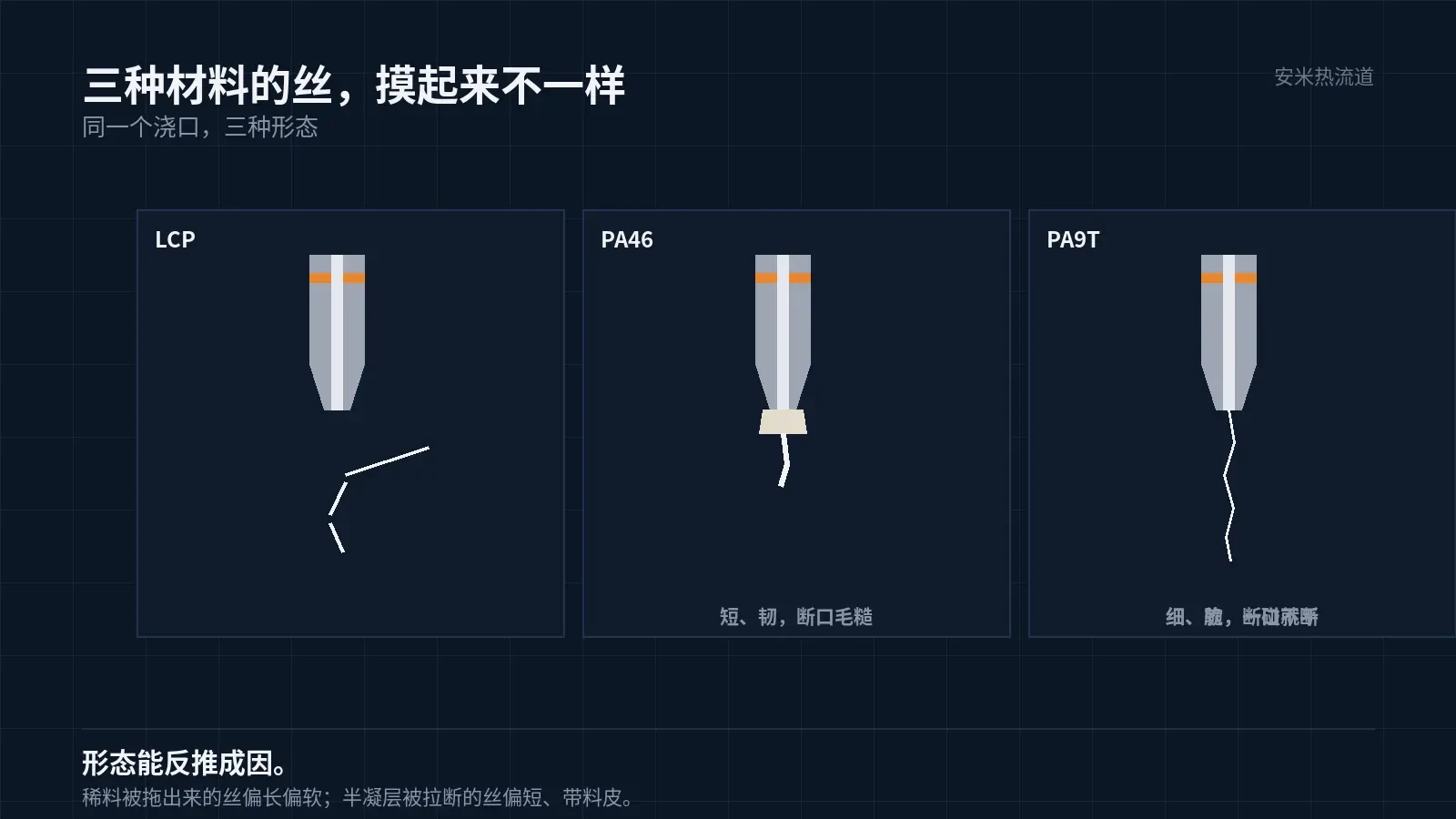
PA46 strands are short, tough, and break cleanly due to rapid crystallization, which forms a semi-solid skin at the exit that snaps during mold opening. PA9T crystallizes more slowly, leaving a pool of low-viscosity melt at the exit.
Different morphologies require opposite treatment strategies. For PA9T, reduce the exit temperature or minimize shear heat; for PA46, lowering the temperature accelerates solid layer formation. Transferring parameters between them will exacerbate the issue.
If you can't tell them apart on-site, twist the string by hand: if it forms an elastic thin strip, it's likely PA46; if it snaps easily with a sharp point, it's likely PA9T or LCP. No instruments needed.
Grade dependency is also critical: PA9T grades with different glass fiber contents exhibit varying viscosities and shear heating. Directly transferring settings when switching grades commonly causes sudden stringing.
Additionally: LCP strings are finer and more brittle, often snapping into multiple segments upon contact; PA9T strings are softer and stretch further before breaking. Three materials, three distinct tactile experiences.
Three steps starting with shear heating
Step 1: Measure the temperature at the nozzle tip exit, not the barrel. The difference between the actual temperature and the setpoint determines subsequent adjustments.
Step 2: Inspect the gate. A smaller gate diameter and longer gate length increase shear rates and shear heat. This is a mold-side issue that cannot be fully compensated by temperature adjustment alone.
Step 3: Adjust temperature and valve pin. Slightly reduce the temperature; avoid large single-step reductions. Set the valve pin closing point near the end of the holding pressure phase to ensure melt cutoff at the gate.
Verify one more valve pin setting: ensure the closing point isn't too tightly synchronized with the mold-open signal. Closing too late leaves melt connected to the part at the nozzle, causing stringing. Closing too early leaves an oversized gate vestige, creating a small protrusion on the part.
Mold opening speed also affects string morphology, not whether strings occur. First resolve if strings appear, then address their quality.
For multi-cavity molds, check if stringing consistently occurs in specific cavities. If so, measure the actual temperature in those cavities first; do not adjust global settings initially.
Two Boundaries
First, do not treat PA9T like PA46. The original datasheet for PA9T does not specify recommended mold temperatures; verify against the customer's actual mold temperature and do not use data from other materials.
Second, avoid continuous temperature reduction. PA9T melts at 300°C. Excessively lowering the outlet temperature may eliminate stringing but can cause nozzle tip clogging and short shots.
For PA9T stringing, first verify three parameters: measured nozzle tip temperature, gate diameter, and glass fiber content. Without clear data on these three factors, parameter adjustments are guesswork.
Provide the material grade, gate dimensions, and current temperature settings. We will review the outlet shear conditions based on the layout diagram and provide a quote after confirming the solution.
MATCHED BY MATERIAL AND DEFECT
This article covers stringing, drooling, clogging, and high-heat resins; refer to SD for gate freeze and break-off.
Register for a selection review and quote
Submit part, mold, and material details. Our engineers will evaluate the gate solution per part and provide a quote.
Upload a 2D layout drawing using the form.
Online selection and quote
Scan to register