
PA46 Stringing: Semi-Solid Layer Tear vs. LCP Behavior
问题排查17 min read
On this page
PA46 filaments feel completely different from LCP. LCP filaments are fine, long, and brittle; PA46 filaments are short, tough, with rough fracture surfaces, sometimes accompanied by a small piece of skin.
Different morphologies indicate different root causes. Applying LCP solutions directly to PA46 typically replaces stringing with nozzle clogging.
String appearance indicates the issue.
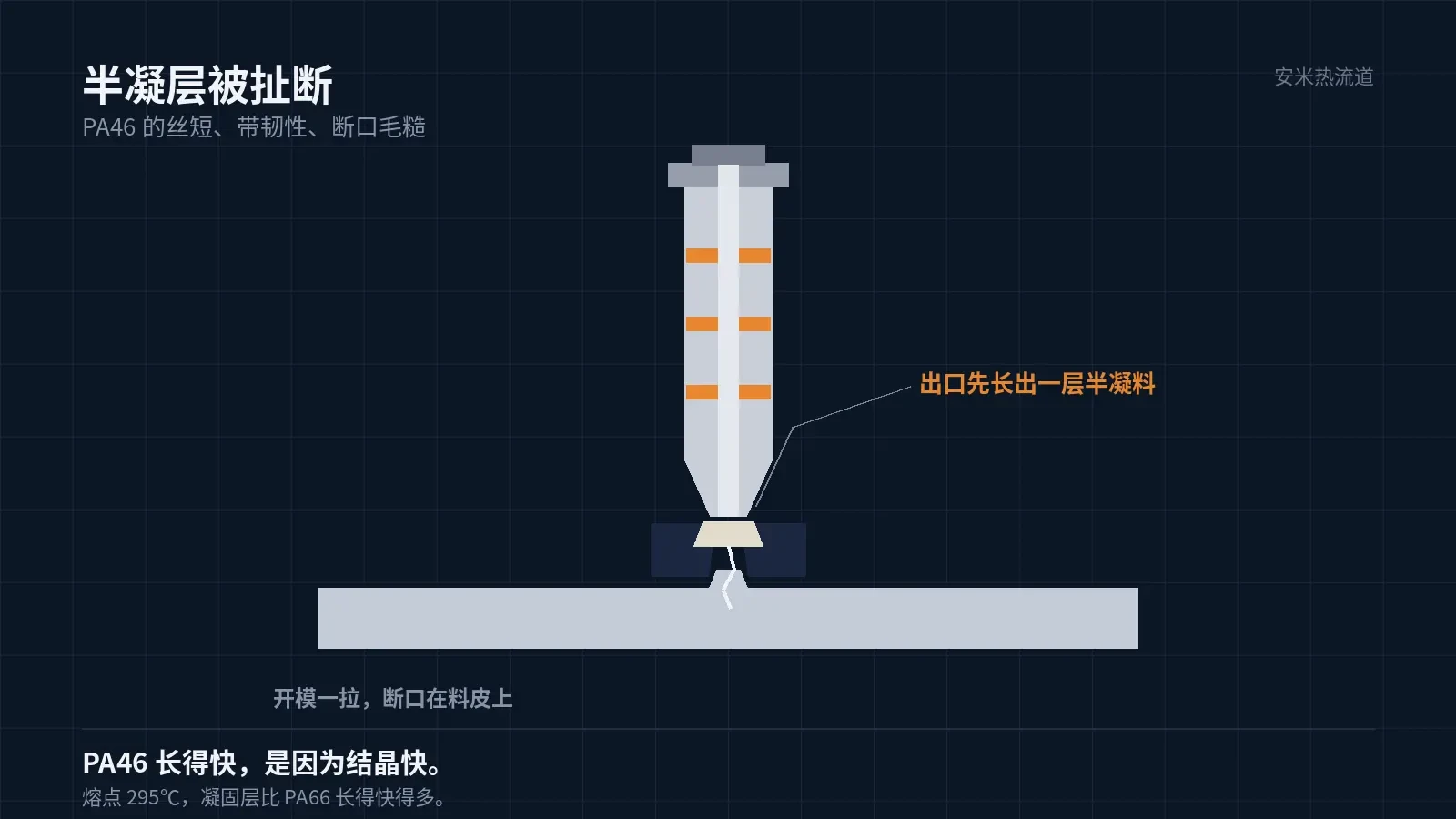
The PA46 stringing location remains at the nozzle tip–gate interface. The exit condition differs: instead of molten material being dragged out, a semi-solidified skin is pulled apart and ruptures.
Why does a semi-solid layer form? PA46 crystallizes rapidly. A solidified layer begins forming as soon as the melt exits the gate; if mold opening occurs before full hardening, this layer breaks.
Further analysis: String length and fracture surface reveal semi-solid layer thickness. Short strings with small skin fragments indicate a strong solidified layer formed at the exit, torn by force (low temperature). Long, thin strings suggest a soft solidified layer pulled out viscously (high temperature or slow mold opening).
Two key material specifications
Envalior Stanyl data provides two critical parameters for field applications: a melting point of 295°C, approximately 30°C higher than PA66; and a rapid crystallization rate with high crystallinity.
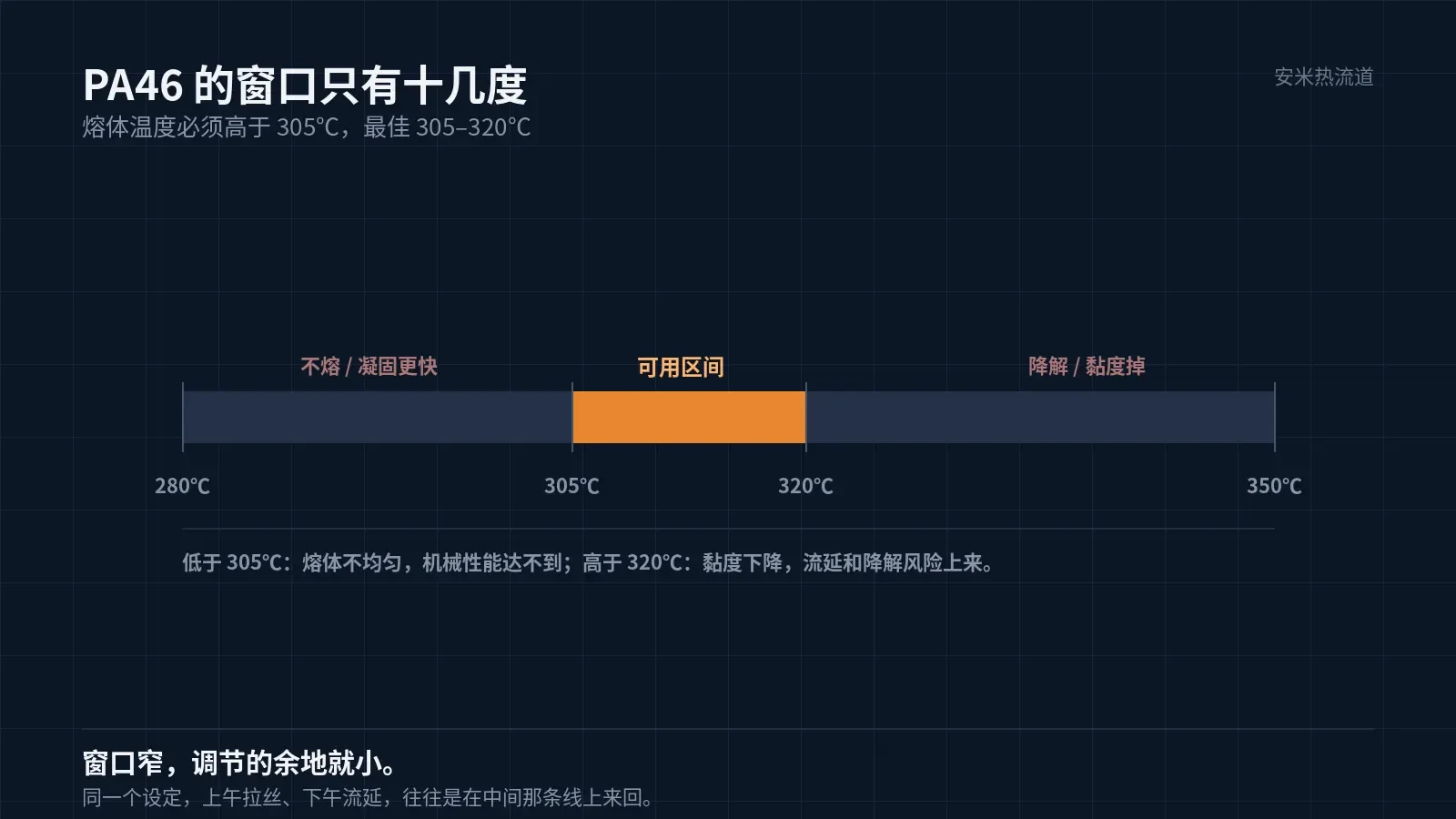
Strict requirement: melt temperature must exceed 305°C, with an optimal range of 305–320°C. Below this temperature, the melt is non-uniform and mechanical properties are not met.
Grade differences must be noted. Even for PA46, materials with different reinforcement ratios or flow grades exhibit varying melt viscosity and crystallization rates, leading to different usable temperature ranges. Directly copying settings from one grade to another during a switch is a common cause of recurring stringing and nozzle clogging.
In shop-floor terms: The 295°C melting point defines the temperature needed for full melt, while the 305°C threshold determines whether the melt remains fluid at the gate. Below 305°C, injection becomes not just difficult—the melt is non-uniform, and molded parts fail to meet mechanical property requirements.
Overall, the processing window is shifted upward and narrowed at both ends. Low temperatures prevent melting and accelerate solidification; high temperatures cause degradation and reduce viscosity. Only about 10°C of temperature range is usable in the middle.
The narrow window means little buffer against mold temperature and ambient conditions. With identical settings, actual outlet temperatures can vary by several degrees between summer and winter, or morning and afternoon. This explains why PA46 stringing issues often resolve one day and recur the next.
Two Consequences of the Narrow Window
If settings are near the lower limit, semi-solidified melt is pushed into the gate. This causes the solidified layer at the exit to grow faster than normal, leading to tearing during mold opening. If settings are near the upper limit, viscosity decreases and solidification slows, shifting the problem to drooling.
Stringing in the morning and drooling in the afternoon on the same machine and mold are not caused by operator error, but because settings fluctuate around the center of the process window.
Why LCP solutions cannot be directly applied
Stringing in LCP is primarily caused by its high sensitivity of viscosity to temperature; lowering the temperature reduces melt fluidity and alleviates the issue. In contrast, PA46 behaves oppositely: lower temperatures accelerate solidification, failing to resolve stringing while causing nozzle clogging first.
Thermal balance also matters. Uneven cavity temperatures cause melt in specific cavities to cool excessively before reaching the gate, leading to premature semi-solid layer formation in those cavities. If PA46 stringing is localized to one or two cavities, measure their actual temperatures first instead of adjusting global setpoints.
Reversing this step will render all subsequent adjustments ineffective.
LCP strands form when low-viscosity melt is drawn out; cooling reduces fluidity. PA46 strands result from semi-solid layers fracturing under tension; cooling accelerates and thickens the solidified layer. These materials exhibit opposite behaviors under the same conditions. Understanding this prevents indiscriminate parameter transfer between them.
Follow these three steps in order
First, verify the actual melt temperature using direct measurement, not just the barrel display. If it is below 305°C, adjust the barrel and hot nozzle temperatures to the correct range before proceeding.
Second, implement cycle-controlled temperature management at the gate. Ensure the target temperature is reached before injection to ensure flowability, remove heat after packing completes to seal the gate, prevent semi-solid layer carryover during mold opening, and restore temperature for the next cycle.
Finally, verify the mold opening motion. Excessive opening speed can still tear semi-solid layers. Adjust this independently of temperature settings, changing only one variable at a time to isolate the cause if issues occur.
Ensure the temperature probe is positioned correctly: near the nozzle tip exit, not at the front of the barrel. For mold opening speed, run a full batch at the current speed and record stringing occurrences. Then test one reduced speed setting and compare results before finalizing. Relying on intuition for speed adjustments prevents effective root cause analysis.
Acceptance criteria are standardized. Connector manufacturers typically evaluate burr height and residual length based on customer drawings and appearance standards. Specific values vary by product, so no universal figures are provided here. However, acceptable thresholds must be documented in work instructions to ensure consistent evaluation across shifts.
For PA46 stringing, first determine the exact melt temperature. Without this data, any further discussion is speculative.
Verify drying conditions. PA46 is hygroscopic; insufficient drying leads to silver streaks, bubbles, and viscosity loss from degradation—not stringing. However, reducing temperature to mitigate stringing may cause premature semi-solidification of under-dried material. When both issues occur simultaneously, identifying the root cause becomes challenging.
Please provide the material grade, barrel temperature settings, and mold layout drawing. We will verify the gate section temperature profile against the layout and provide pricing after confirming the solution.
MATCHED BY MATERIAL AND DEFECT
This article covers stringing, drooling, clogging, and high-heat resins; refer to SD for gate freeze and break-off.
Register for a selection review and quote
Submit part, mold, and material details. Our engineers will evaluate the gate solution per part and provide a quote.
Upload a 2D layout drawing using the form.
Online selection and quote
Scan to register