
Why does PA46 clog within one or two shots? What if it drops below the window lower limit?
问题排查16 min read
On this page
PA46 clogs faster than LCP. If the temperature falls below the set window, the gate may seal within one or two shots; subsequent shots will be empty.
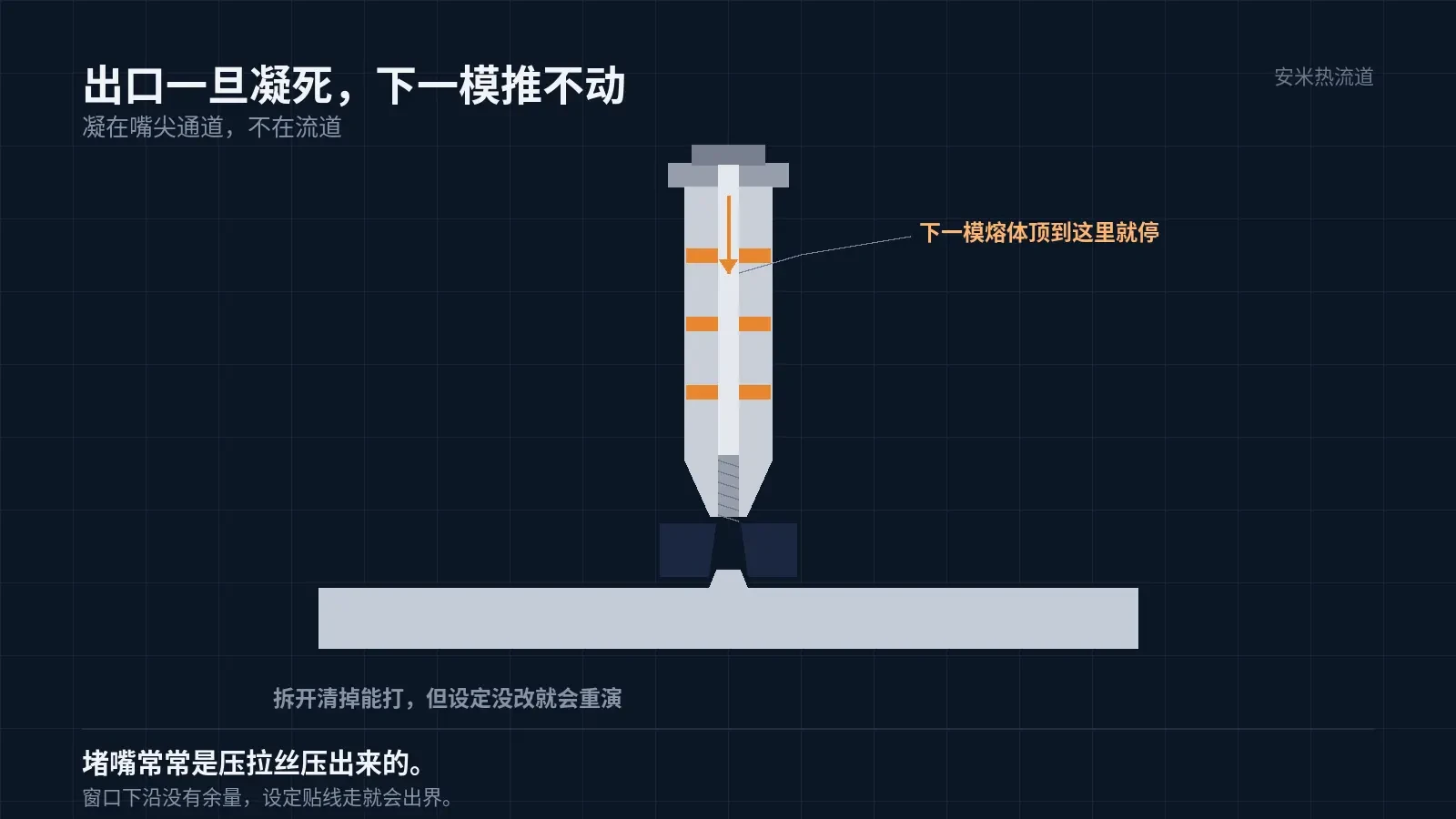
Remove the nozzle tip; hardened material is present in the channel. Cleaning will restore production, but recurrence is likely during the next setup as this material has no process margin.
Blockage Location
The blockage occurs in the nozzle tip's short internal channel and at the gate exit. PA46 solidifies quickly; once a solid layer forms in the channel, the melt from the next shot cannot pass through, causing short shots or complete fill failure.
Unlike LCP clogging, which manifests as a gradual transition from temperature drop to sealing—often showing visible signs like short shots or incomplete filling—PA46 typically skips this phase. The previous shot appears normal, but the next one is empty. This difference means PA46 requires proactive measures rather than reactive fixes after problems occur.
Raising injection pressure only increases resistance against the solidified layer, triggering machine overload alarms while the part remains short-shot.
The speed difference is due to material properties. PA46 crystallizes rapidly; the melt forms a solidified layer immediately after exiting the gate, sealing narrow channel sections within just a few shots. LCP also solidifies quickly, but its viscosity changes more sharply—typically showing stringing and drooling before clogging occurs.
The 305°C Threshold
PA46 melts at 295°C. Official requirements mandate a melt temperature above 305°C, with an optimal range of 305–320°C. There is no margin below this range.
Lower temperatures cause uneven melting and poor mechanical properties, while also speeding up solidification. The nozzle tip is the most heat-loss-prone section in the entire hot runner assembly; setting it close to 305°C means actual temperatures slightly below this will fall out of spec.
Note: Original manufacturer data does not specify recommended hot runner and mold temperatures for PA46. These values must be determined through actual measurements and cannot be extrapolated from other grades. 305°C is the maximum melt temperature limit; hot runner settings must account for the temperature drop from the manifold to the nozzle tip.
Lowering the temperature to reduce stringing is the most common cause of nozzle clogging in PA46. Operators think they are solving stringing, but they are actually causing clogs.
Three scenarios: select the one that applies
Settings are too low, especially when adjusted to reduce stringing.
Prevention costs less than remediation. Measuring actual temperatures before each shift and recording heater band and thermocouple status saves far more than disassembling molds after nozzle sealing. The PA46 processing window has no margin; relying on post-failure recovery results in losses every time.
The nozzle tip presses firmly against the mold, maximizing contact area to draw away heat and keep the actual temperature lower than displayed.
Start immediately after shutdown or mold change, without allowing the first few shots to reach a stable outlet temperature.
In multi-cavity molds, only one cavity may seal. First, check if that cavity's heating circuit is broken or if the thermocouple has detached, then inspect the gate insert fit for that cavity. Only review overall settings and shutdown procedures if all cavities seal simultaneously.
It shares the same knob as stringing.
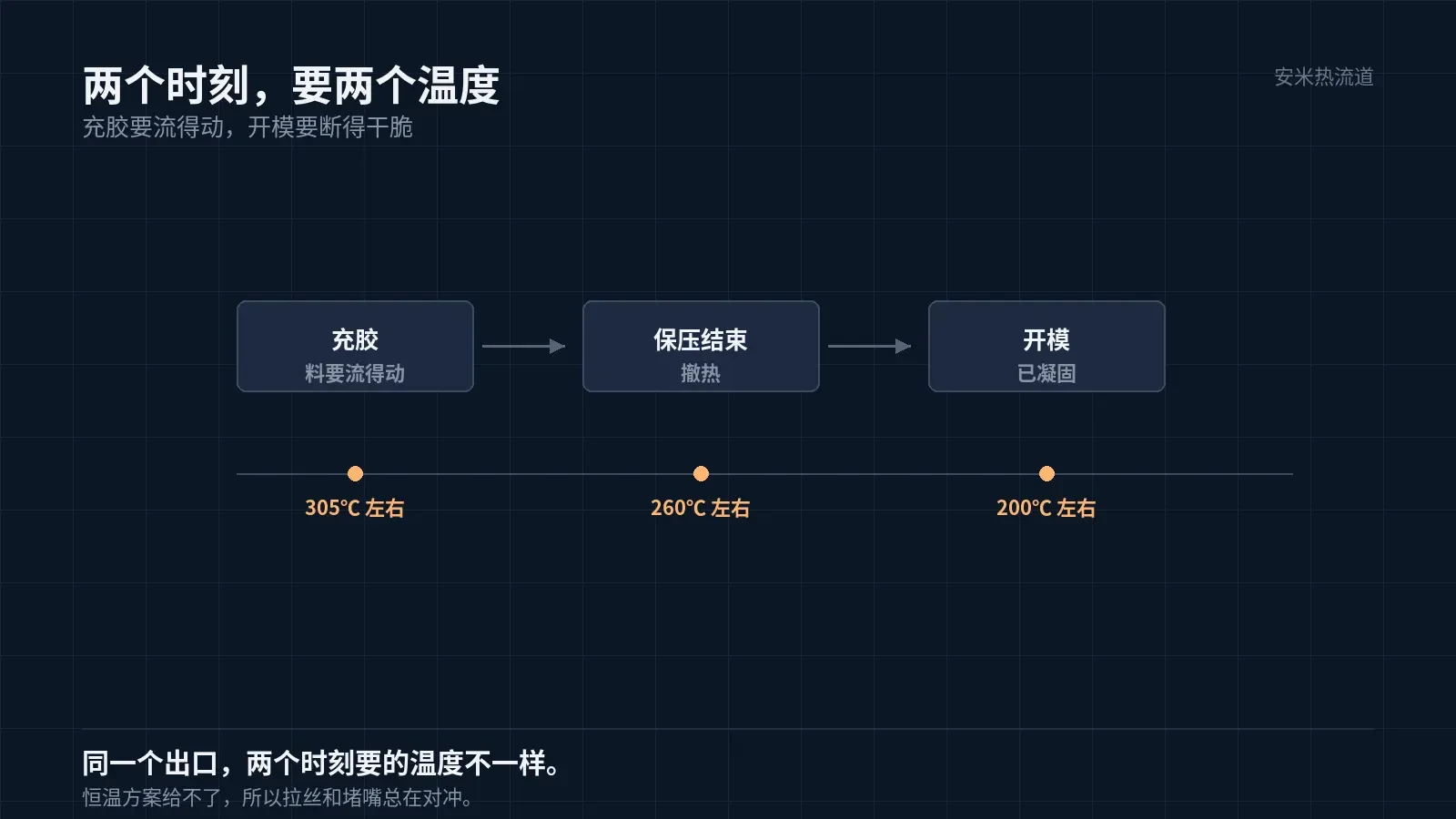
Stringing occurs when the semi-solidified layer breaks, while clogging results from solidification at the outlet. Both are controlled by gate temperature. For materials with a narrow processing window, adjusting in either direction provides quick fixes but quickly triggers issues on the opposite side.
A constant temperature scheme uses a single setpoint. This trade-off cannot be resolved, so field experience must find a point that is barely acceptable for both, which is typically unstable.
The trade-off margin is particularly narrow for PA46. LCP offers a wider window, allowing compromise within a two-degree adjustment; PA46 has only about ten degrees of usable range, so two degrees represent a significant portion. As a result, the barely acceptable point found in the field often lasts only one shift.
Verify sequentially; do not skip steps
Step 1: Use a pyrometer to verify the actual melt temperature, confirming it falls within the 305–320°C range instead of relying on the barrel display.
Step 2: Verify the fit between the nozzle tip and the mold. If the fit is too tight or the contact area is large, temperature control cannot compensate; this requires mold-side modification.
Step 3: Implement cyclic temperature control for the gate. Heat before injection, cool after holding pressure to seal, ensure no residue remains during mold opening, and reheat for the next shot. This prevents clogging and stringing proactively.
Corrective actions must be precise. After clogging, simply increasing injection pressure is ineffective: first raise the nozzle tip temperature to melt the solidified layer, then clean the nozzle, and finally reset settings to the mid-range of the window. Avoid large incremental increases; exceeding 320°C causes stringing and degradation.
For PA46 nozzle clogging, first verify the melt temperature is within range, then check nozzle tip compatibility. Adjust parameters only after both checks pass.
Record keeping is valuable. Log the time of each clogging event, current settings, downtime status, and mold temperature. Within a month, patterns will emerge—such as whether issues cluster after shift changes or consistently affect specific cavities. Identifying these patterns enables effective corrective action.
On startup, first verify outlet flow: perform an empty shot to check material flow, then a second shot to inspect product gates. Do not wait for a full cycle to assess; PA46 clogs quickly, so early detection avoids one mold disassembly.
Send the material grade, temperature settings, and mold layout diagram. We will verify gate section temperature curves and nozzle tip fit, then provide a quotation once the solution is confirmed.
MATCHED BY MATERIAL AND DEFECT
This article covers stringing, drooling, clogging, and high-heat resins; refer to SD for gate freeze and break-off.
Register for a selection review and quote
Submit part, mold, and material details. Our engineers will evaluate the gate solution per part and provide a quote.
Upload a 2D layout drawing using the form.
Online selection and quote
Scan to register