
PPS Nozzle Clogging: Carbonization vs. Insufficient Temperature
问题排查16 min read
On this page
A customer reported PPS connector nozzle clogging attributed to carbon buildup. Upon disassembly, the nozzle tip showed no charred residue—only a hardened block matching the raw material's color.
The causes of nozzle clogging in PPS and PA46 differ. The original manufacturer's statement illustrates this point.
Manufacturer's Statement
DURAFIDE technical data shows that even with prolonged residence in the barrel, its viscosity does not increase significantly, confirming effective hot runner performance.
This indicates that PPS is resistant to degradation and carbon accumulation. Therefore, associating nozzle clogging with carbon buildup is likely inaccurate for PPS.
This also affects selection: Hot runners for PPS are approved by the material supplier. Therefore, when issues occur, check exit temperature and process parameters first before questioning the hot runner's suitability.
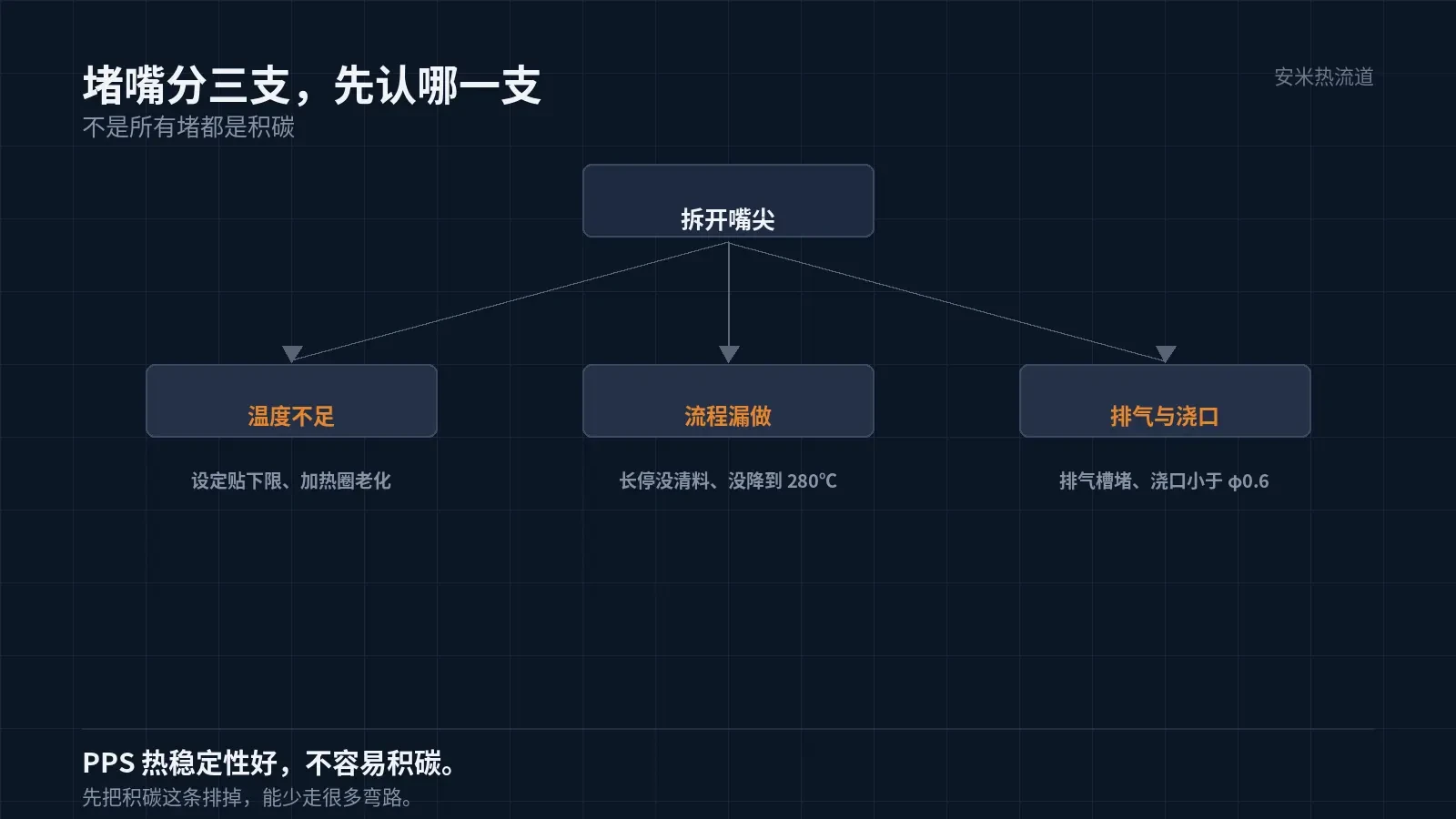
The root causes are typically low temperature and improper processing procedures.
Insufficient Temperature Factor
PPS nozzle temperature is 310–320°C, with a mold temperature of 150°C. The high mold temperature minimizes the temperature difference between the nozzle tip and the mold, reducing heat loss.
However, the nozzle tip has low thermal capacity, and heater band compensation is delayed. If setpoints are near the lower limit, or if heater bands age or thermocouples have poor contact, the actual outlet temperature may drop.
Heater band degradation is gradual: resistance increases and output power drops, so panel temperatures may appear normal even as actual heating lags. By the time clogging occurs, degradation has often been underway for a long time. Regularly measuring resistance is more cost-effective than disassembling the mold after failure.
The maximum melt temperature is 360°C to prevent thermal decomposition. This is a hard upper limit, not adjustable headroom; do not treat it as a safety margin.
Note that OEM specifications for PPS injection pressure are 40–70 MPa, typically ranging from 30–100 MPa. Insufficient pressure can also cause short shots; do not misdiagnose this as clogging. Check the pressure curve first, then inspect the nozzle tip.
Use direct temperature measurement, not panel readings, for diagnosis. Measure near the nozzle tip outlet to determine actual deviation. If the discrepancy is significant, check the heater band and thermocouple before adjusting settings.
Process Considerations
OEM requirements mandate purging during extended downtime and reducing barrel temperature below 280°C. Failure to purge or cool down can cause material to solidify deep within the hot nozzle, requiring prolonged reheating upon restart.
Another requirement involves the startup sequence: heat to the target temperature, run several dry cycles to verify flow, then start production. Skipping dry cycles causes initial empty shots, which are often mistaken for clogging but actually indicate insufficient temperature recovery.
Mold changes also impact performance. After swapping molds, the fit between the sprue bushing and nozzle tip may shift, increasing contact area and accelerating heat dissipation. Failing to record this can cause recurring issues.
For PA46 nozzle clogging, the setting is often at the window's lower limit; for PPS, it typically stems from inadequate process and temperature control. Same symptom, different causes: identify the material first.
After mold changes, re-verify the fit between the nozzle tip and gate insert. A tight fit with a large contact area increases heat dissipation, leading to performance differences before and after the change under identical temperature settings.
Another type of false blockage
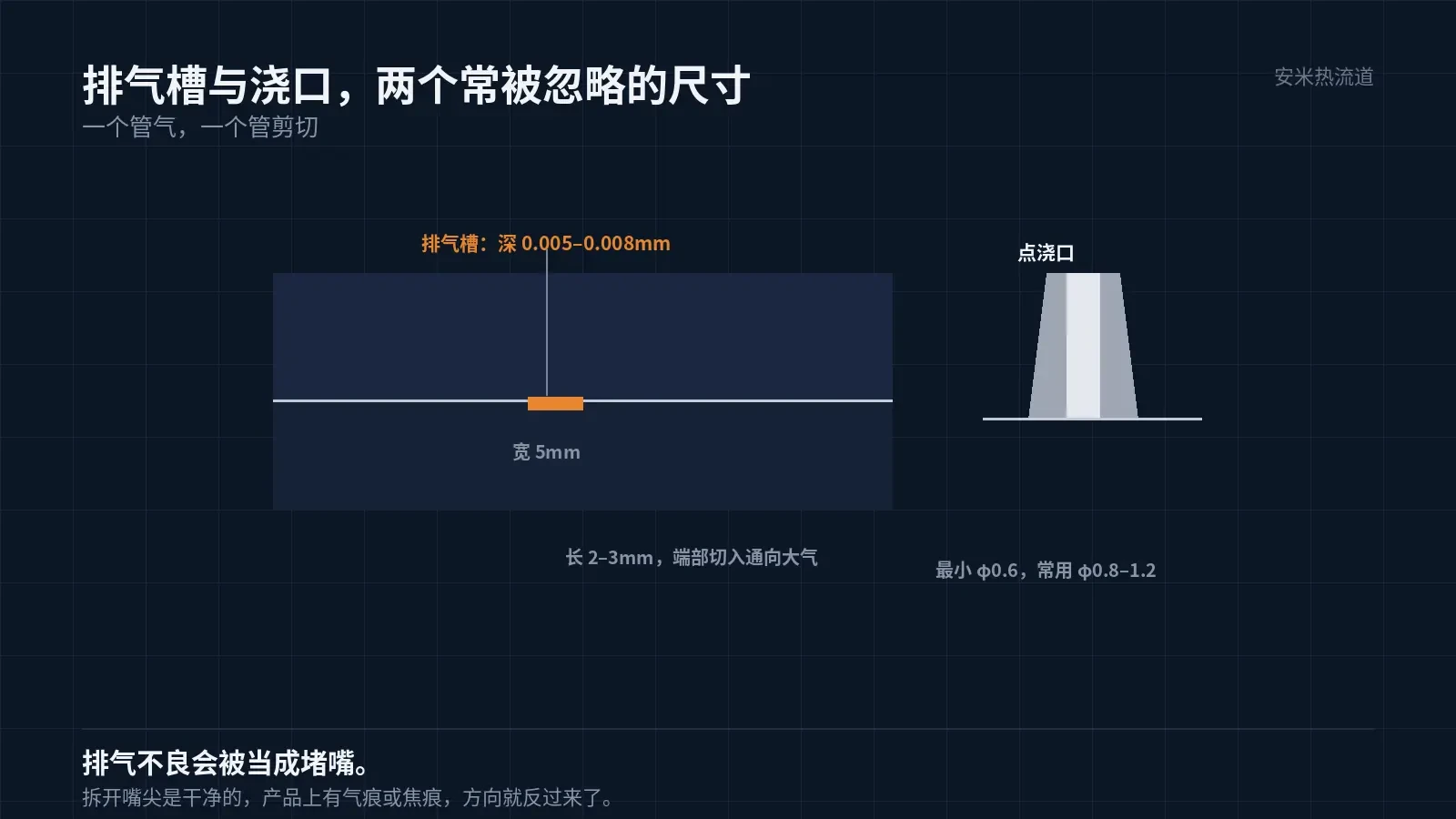
Poor venting also causes short shots. Recommended PPS vent dimensions: depth 0.005–0.008 mm, width 5 mm, length 2–3 mm, with ends cut into the mold by 0.5–1 mm to atmosphere.
Shallow vents or those blocked by carbon buildup trap air in the cavity, leading to short shots and burns that mimic nozzle clogging. Differentiation: The nozzle tip is clean upon disassembly, but parts show gas marks or burn traces.
Vents need regular cleaning. Carbon buildup blocking half of a 0.005–0.008 mm deep vent renders it ineffective. Clearing vents during mold maintenance is faster than troubleshooting issues later.
Keep a simple log: date, mold number, clogging time, settings used, downtime status, and debris type. One month of data reveals whether the cause is temperature, process, or wear. Without records, every issue requires guesswork.
Gate size is another factor. The minimum pin-point gate diameter is φ0.6 mm, typically 0.8–1.2 mm; smaller sizes promote glass fiber accumulation at the gate.
Troubleshooting Steps
First, disassemble and identify the clogging material. Next, reheat and clean the nozzle tip. Then, measure the gate diameter and vent groove dimensions. Finally, adjust the process settings.
Do not raise the temperature too much at once. Temperatures above 320°C can cause stringing and decomposition. The maximum limit is 360°C, leaving very little margin.
When raising the temperature, monitor two indicators: melt flow consistency and gate cleanliness on the part. Proceed to the next increment only if both are satisfactory. Increasing the temperature too much at once often causes immediate stringing.
PPS exhibits very low post-shrinkage and is officially specified as highly suitable for precision molding. Annealing conditions are typically 100–120°C for approximately 1 hour(s). Consequently, dimensional stability generally remains unaffected after resolving nozzle clogging issues, offering greater reliability compared to PA46.
For PPS nozzle clogging, first verify material properties: it does not readily accumulate carbon deposits. This understanding prevents unnecessary focus on carbon cleaning procedures.
Please provide the material grade, shutdown procedure, and gate dimensions so we can verify outlet temperature and venting requirements. Pricing will be provided after confirming the solution.
MATCHED BY MATERIAL AND DEFECT
This article covers stringing, drooling, clogging, and high-heat resins; refer to SD for gate freeze and break-off.
Register for a selection review and quote
Submit part, mold, and material details. Our engineers will evaluate the gate solution per part and provide a quote.
Upload a 2D layout drawing using the form.
Online selection and quote
Scan to register