
PEI Stringing: Why Cooling Alone Fails to Break Strings
问题排查15 min read
On this page
PEI stringing behaves differently from semi-crystalline materials: strings are thin, tough, and elongated with sharp fracture points. Lowering the melt temperature shortens the strings but often fails to break them completely, leaving small segments hanging.
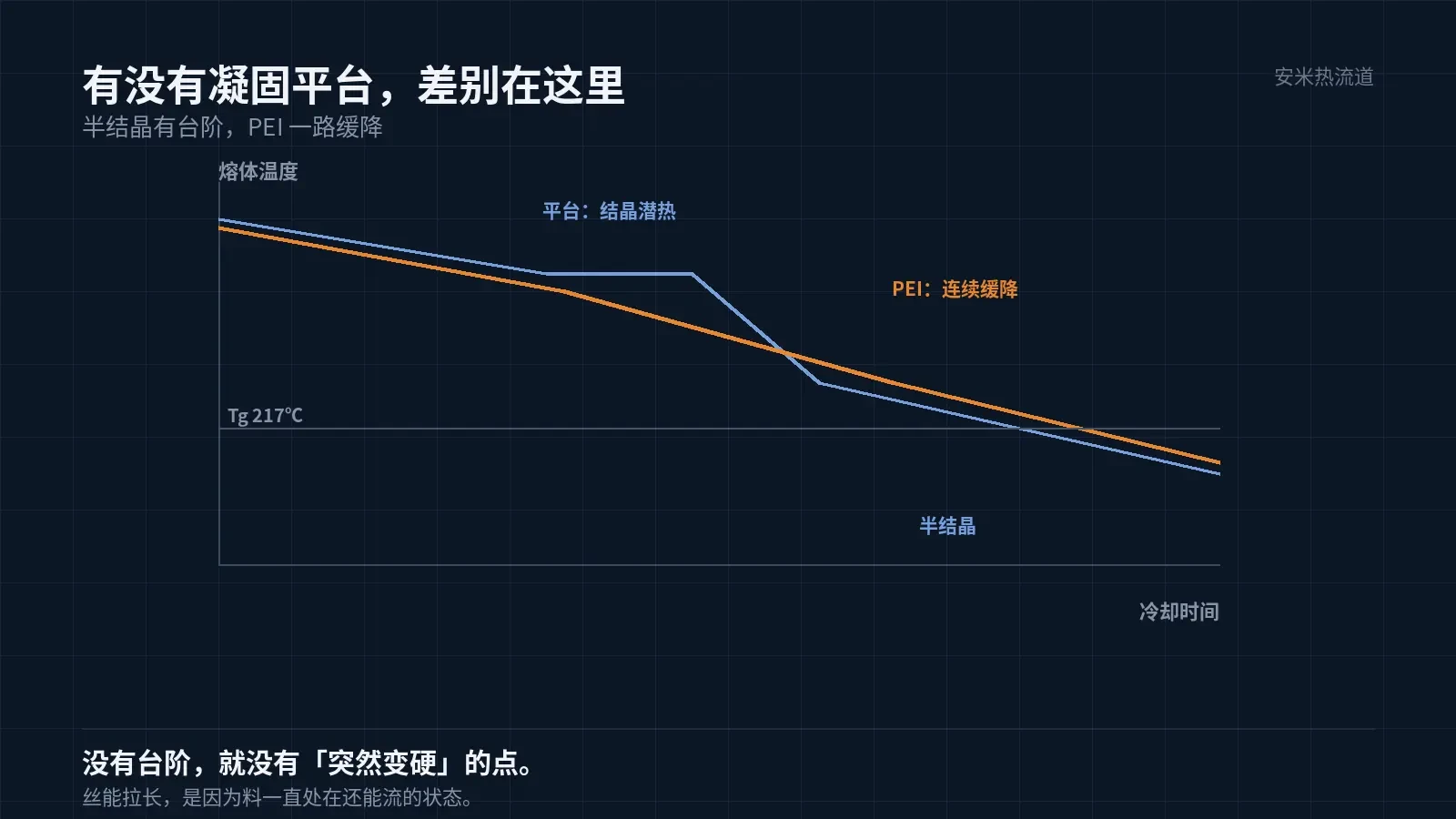
The issue isn't insufficient cooling; PEI has no melting point. As an amorphous material stabilized by its glass transition temperature (Tg), it does not undergo a sudden solidification step during cooling.
Amorphous Structure Implications
Semi-crystalline materials show a plateau near the melting point during cooling: as crystallization latent heat is released, the temperature stabilizes briefly before the material rapidly hardens. LCP, PA46, PA6T, PPS, and PEEK all exhibit this behavior.
PEI does not. With a Tg of 217°C, viscosity increases continuously as the melt cools, with no sudden hardening point.
Consequently, gate exit material can stretch significantly before breaking through thinning and rupture rather than brittle fracture. Thus, cooling helps but is often insufficient.
This means PEI string removal requires both cooling and mechanical cutting.
Quick on-site check: Raise the mold temperature from 150°C to 170°C. If the filaments lengthen significantly, slow cooling is the cause. If the filament length stays nearly the same, the issue is with break timing; no temperature adjustment is needed.
350–410°C and 135–180°C
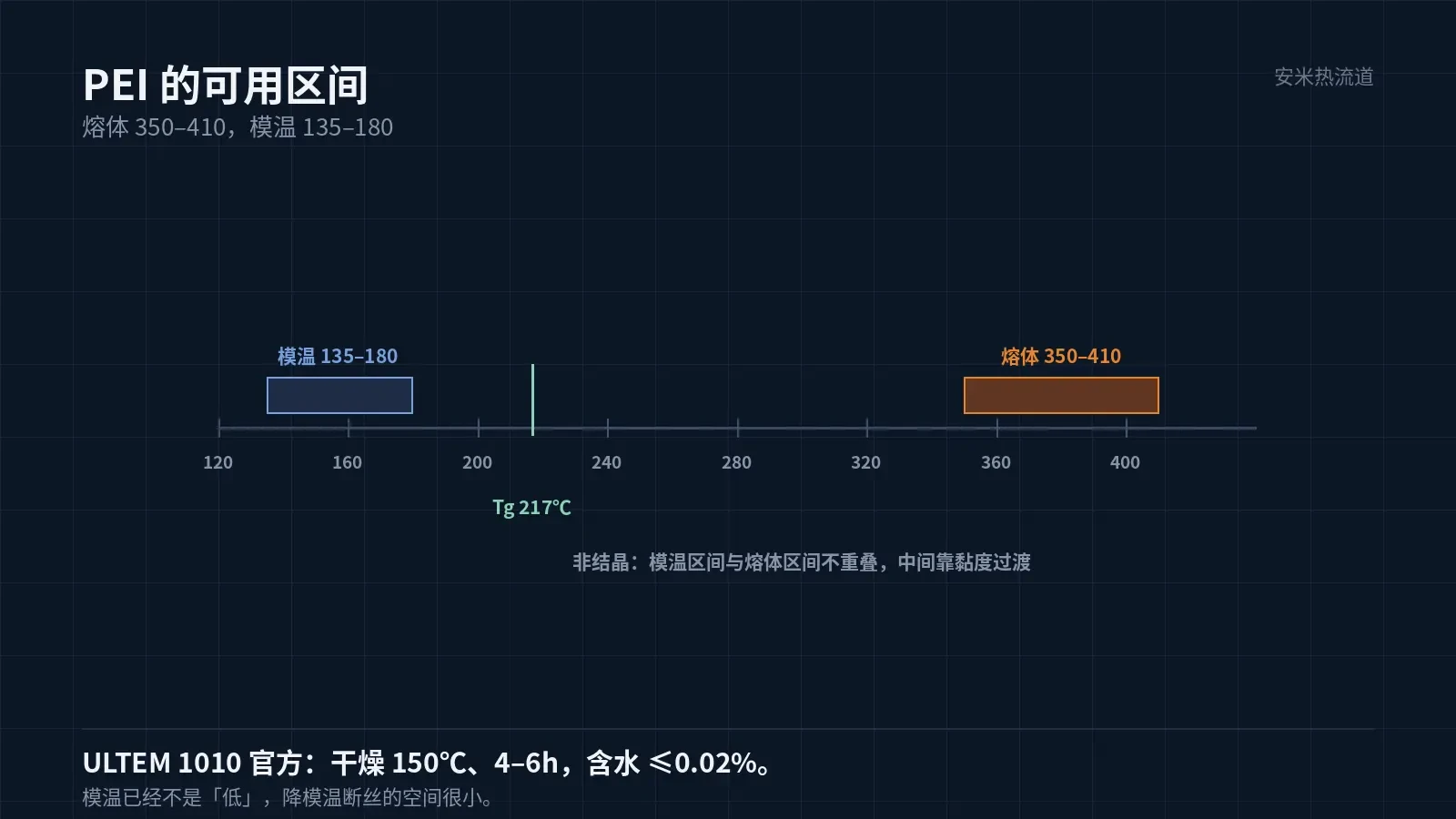
Official processing data for ULTEM 1010: melt temperature 350–410°C, nozzle temperature 345–405°C, mold temperature 135–180°C; dry at 150°C for 4–6 hours with moisture content ≤ 0.02%.
The wide melt temperature range occurs because amorphous materials are less sensitive to temperature changes than semi-crystalline ones, providing greater flexibility in adjusting flowability through temperature.
However, a wide range does not mean arbitrary selection. High settings increase the risk of degradation; low settings hinder thin-wall filling and make stringing harder to break.
With mold temperatures already at 135–180°C, lowering them to eliminate stringing offers little margin and risks internal stress and dimensional issues.
High mold temperatures raise part temperature during ejection, causing parts to become soft and prone to deformation when removed or placed. This is often mistaken for a mold defect but actually results from improper mold temperature settings and insufficient cooling time.
Why strings are tough
PEI has rigid molecular chains and high melt strength. As temperature drops, viscosity increases while chain entanglement remains, enabling significant string stretching.
Bubbles or silver streaks on the strings indicate moisture exposure or material degradation; the root cause is the material itself, not just stringing.
A smooth, tapered fracture indicates pure mechanical stretching; a rough, torn fracture suggests cold material or foreign objects at the gate exit.
Valve gates are more effective here.
In AM Industry's product lineup, the SD, VG, and PVG series are all compatible with PEI. This differs from the PA6T group, where only the SD series is recommended.
PEI's high melt strength allows the valve pin to fully shut off material flow when closed, preventing stringing caused by incomplete cutoff before solidification.
Therefore, the top priority for addressing PEI stringing is not temperature, but the cutoff position and timing: when to close the valve pin, how far to open it, and whether to apply additional holding pressure after closure.
If the timing is off, adjusting the temperature to the limit won't help: if the pin closes too late, the material will already be pulled out.
Coordinate timing with holding pressure. If the valve pin closes too early, holding pressure cannot transmit, causing sink marks; if it closes too late, material is dragged out. The optimal point is typically at the end of the holding phase, determined by trial rather than calculation.
Processing Sequence
First, confirm the gate type. For SD series, assume "cutoff via Fast Cooling" before checking temperature; for VG/PVG series, verify timing first.
2. Measure the actual melt outlet temperature, not the setpoint. Amorphous materials are insensitive to temperature but sensitive to residence time.
3. Adjust the valve gate closing point by advancing it earlier from the end of holding pressure; observe changes in stringing length.
4. Reduce residence time. PEI degrades if held too long near 400°C; degraded material causes longer and stickier stringing.
5. Adjust melt temperature last only, in 5°C increments; verify thin-wall filling and appearance after each change.
Re-validate when changing grades. ULTEM 1010 is unfilled; glass-filled grades have different flow and shear behavior. Directly transferring parameters will affect stringing and appearance.
Two Boundaries
Do not operate continuously at the 410°C upper limit. This is a maximum threshold, not a recommended setting; prolonged use near this limit accelerates degradation and exudation.
Do not rely on lowering mold temperature as the primary solution. If the mold temperature drops below 135°C, internal stress, warpage, and dimensions may change, and stringing may not resolve cleanly.
Another often overlooked factor: ejection. PEI has high melt strength and strong mold adhesion. If ejection is problematic, lowering the mold temperature can lead to incomplete stringing resolution and part deformation. Address ejection issues separately.
Specify the gate type, valve gate timing, outlet temperature, and stringing characteristics. We will evaluate your requirements against these criteria and provide pricing once the solution is confirmed.
Valve pin timing should be based on the time the valve is fully closed, not when the command is issued; there is a delay between the two.
MATCHED BY MATERIAL AND DEFECT
This article covers stringing, drooling, clogging, and high-heat resins; refer to SD for gate freeze and break-off.
Register for a selection review and quote
Submit part, mold, and material details. Our engineers will evaluate the gate solution per part and provide a quote.
Upload a 2D layout drawing using the form.
Online selection and quote
Scan to register